
🌱
Ceropegia woodii – Detailed Botanical Description
Ceropegia woodii is a trailing and occasionally climbing succulent-tending species belonging to the family Apocynaceae. It is commonly referred to as:
- String of Hearts
- Rosary Vine
- Chain of Hearts
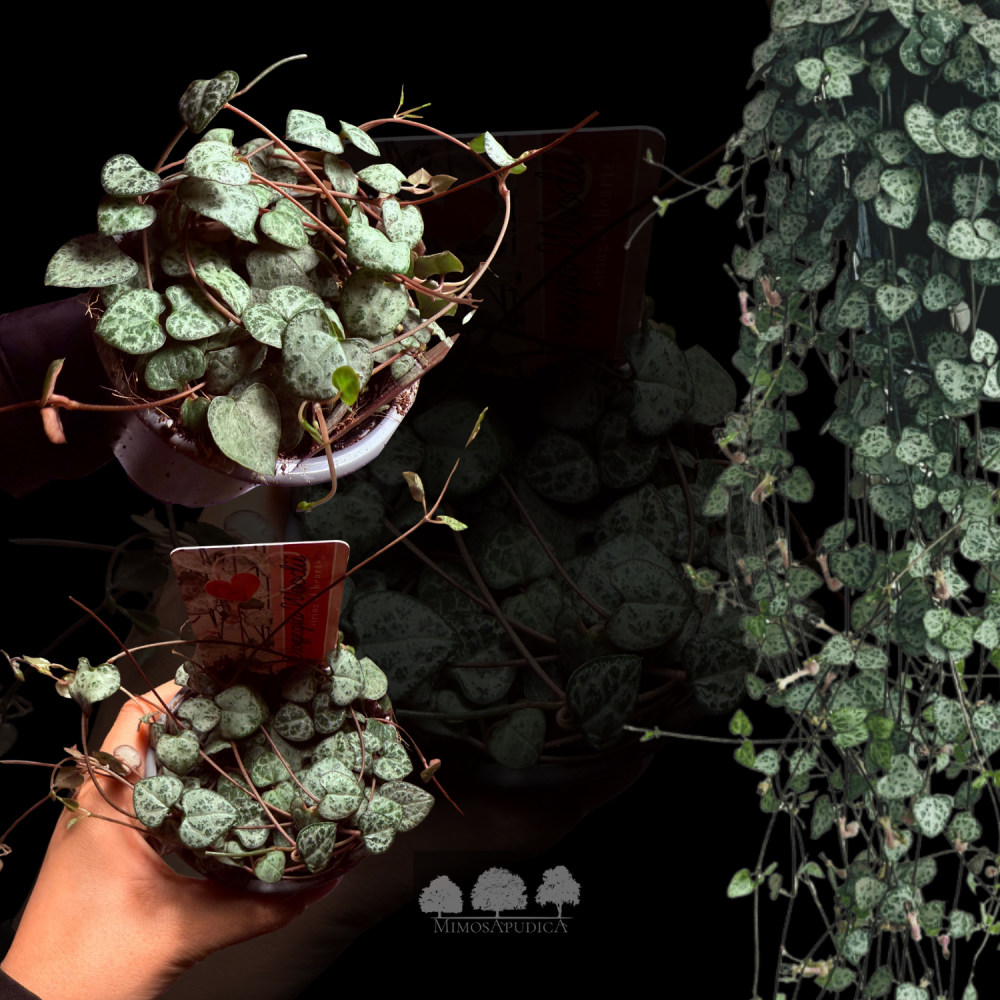
Its morphology is defined by slender pendulous stems bearing opposite, cordate leaves that create a distinct geometric and symmetrical visual pattern.
🌿
Morphology
- Leaves: Small, heart-shaped, slightly succulent, displaying a mottled green surface with silver variegation; the abaxial (lower) surface often develops purplish to pink tones under sufficient light exposure.
- Stems: Fine, filamentous, and elongated, gradually turning purplish with maturity; internodes can generate aerial rootlets.
- Flowers: Tubular, lantern-shaped, and morphologically specialized, exhibiting a complex corolla structure typical of the genus Ceropegia, designed to support highly selective pollination systems.
- Roots: Capable of forming nodal tubers (tuberous swellings) along the stem, facilitating vegetative propagation without intervention.
🌍
Habitat and Natural Range
Native to:
- South Africa
- Mozambique
- Eswatini (formerly Swaziland)
- Botswana
It naturally inhabits semi-arid rocky slopes, shallow crevices, and sandy organic substrates, where stems may trail over stones or cling loosely to surrounding vegetation.
🌡️
Environmental Requirements
- Light: Prefers bright, indirect light; tolerates higher light intensities if acclimated gradually.
- Watering: Requires complete substrate drying between irrigations due to its semi-succulent water-retention physiology.
- Soil: Well-draining mix combining mineral grit with light organic matter.
- Humidity: Not humidity-dependent; adapts to varied indoor levels.
- Temperature: Optimal range between 18–26°C, with avoidance of significant cold exposure.
🧬
Adaptive Features
- Storage of water in leaves and stems to endure intermittent drought.
- Development of nodal root systems to stabilize growth and facilitate natural spread.
- Leaf morphology supports reduced transpiration, aligning with conditions of its semi-arid origin.
🪴
Growth Characteristics
- Capable of developing long cascading vines exceeding 2–3 meters under stable conditions.
- Responds well to pruning, which enhances lateral branching and increases foliar density.
- Exhibits intensified pigmentation (purple hues) under enhanced light conditions during active growth periods.
🌸
Floral Biology
- The corolla is structurally adapted to specific small pollinators.
- Flower morphology is associated with entrapment-based pollination mechanisms characteristic of Ceropegia species.
🧪
In Controlled Plant Systems
- More suited to open terrariums or hanging systems than fully sealed humid micro-environments.
- Maintains structural clarity and foliar integrity in moderate-light, low-humidity climates.
📌
Additional Notes
- Classified as mildly succulent due to its internal water storage capability.
- Serves as a model species for examining anatomical drought adaptation and climbing behavior in thin-stemmed taxa.
- Its form reflects a balance between structural simplicity and physiological specialization.